
VO2 max is the gold standard measure of aerobic fitness, but its value goes far beyond a
single number. Here is what current research tells us about VO2 max testing, how it is used
by elite and recreational endurance athletes, and why getting tested in Dubai could be the
most useful thing you do for your training this year.
WHAT IS VO2 MAX AND WHY DOES IT MATTER?
VO2 max is the maximum rate at which your body can consume oxygen during intense exercise. It is expressed in millilitres of oxygen per kilogram of body weight per minute (ml/kg/min) and is widely regarded as the single best objective measure of cardiovascular fitness and aerobic capacity.
The higher your VO2 max, the more oxygen your working muscles can use, and the greater your capacity for sustained high-intensity effort. For endurance athletes, runners, cyclists, triathletes, rowers, swimmers, VO2 max is one of the most reliable predictors of performance. An elite male marathon runner typically has a VO2 max above 70 ml/kg/min. Eliud Kipchoge, the world marathon record holder, has been measured at approximately 85. A healthy but untrained adult male sits around 35–45.
But here is what most people miss: VO2 max is not just a number to compare against others. The real value of a VO2 max test lies in what it reveals about your physiology, and how that information can be used to train more precisely, recover more effectively, and perform at a level that guesswork simply cannot deliver.
THE SCIENCE: WHAT CURRENT RESEARCH TELLS US
VO2 max is trainable — but has a ceiling
Research consistently shows that VO2 max can be improved through training, typically by 10–20 percent in untrained individuals and 5–10 percent in those already moderately fit. Highly trained athletes show smaller gains because they are already operating closer to their genetic ceiling. High intensity interval training (HIIT) and sustained aerobic volume both contribute to VO2 max improvements, but the relative contribution depends on the individual’s current fitness level and training history, which is exactly why baseline testing matters.
VO2 max predicts more than athletic performance
A growing body of research has established VO2 max as one of the strongest independent predictors of all-cause mortality, more predictive than blood pressure, cholesterol, or body weight. A landmark study published in JAMA Network Open found that low cardiorespiratory fitness carried a higher relative risk of death than smoking, diabetes, or hypertension. This has shifted the clinical conversation around VO2 max testing from purely athletic to broadly medical. Knowing your VO2 max is not just useful for race day, it is a meaningful marker of long-term health.
Lactate threshold matters as much as VO2 max
More recent sports science research has highlighted that lactate threshold, the exercise
intensity at which lactate begins to accumulate faster than the body can clear it, may be an even more powerful predictor of endurance performance than VO2 max alone. Two athletes with identical VO2 max values can have very different performance outcomes if their lactate thresholds occur at different percentages of their maximum.
This is why modern VO2 max testing, including cardiopulmonary exercise testing (CPET) goes beyond measuring peak oxygen consumption. A comprehensive test identifies both the first lactate threshold (the point where breathing first becomes laboured) and the second lactate threshold (the point beyond which effort becomes unsustainable), giving a precise picture of the training zones that will produce the most adaptive response.
Heart rate zones based on feeling are not good enough
Most recreational athletes train using heart rate zones derived from age-based formulae such as 220 minus age. Research shows these formulae carry a standard deviation of approximately 10–12 beats per minute, meaning for a significant proportion of athletes, their calculated zones are meaningfully wrong. Training consistently in the wrong zones is one of the most common reasons athletes plateau, overtrain, or fail to develop the aerobic base they are working towards. A VO2 max test replaces population averages with your actual physiology.
WHAT A VO2 MAX TEST ACTUALLY INVOLVES
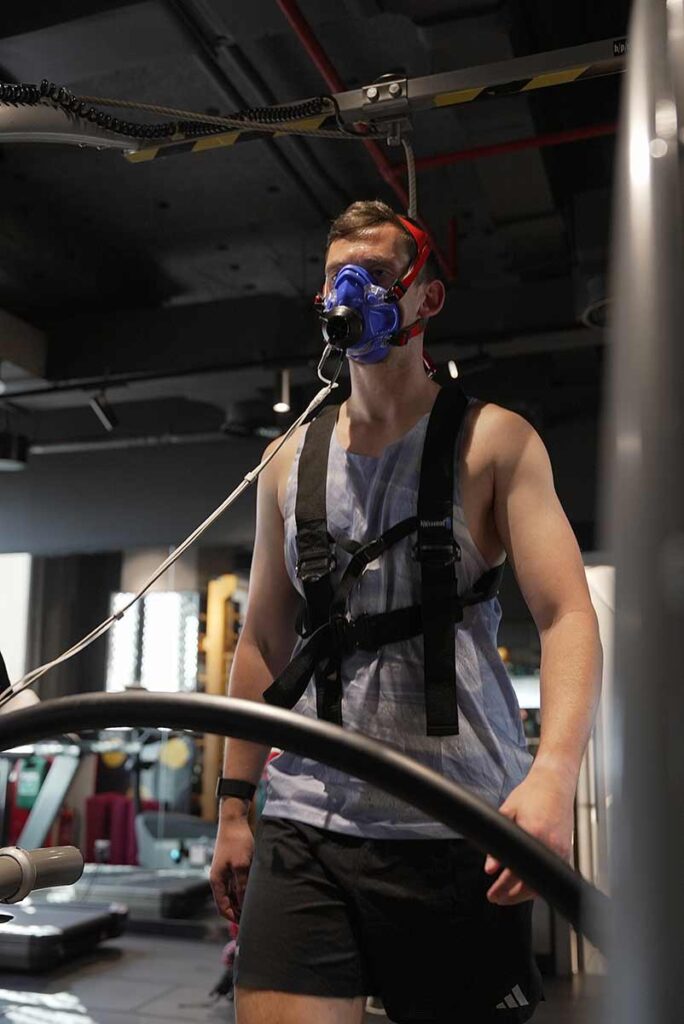
A cardiopulmonary exercise test (CPET), the clinical gold standard for VO2 max measurement is conducted on a treadmill or cycle ergometer while the patient breathes through a mask connected to a metabolic analyser. The test uses a graded protocol: intensity increases incrementally every one to three minutes while the analyser measures oxygen consumption, carbon dioxide output, ventilation, and heart rate in real time.
The test typically lasts between 8 and 15 minutes. It is uncomfortable at peak intensity, that is by design, as a true VO2 max requires maximal effort, but it is safe when conducted with appropriate medical oversight. At UPANDRUNNING, all CPET testing is supervised by Dr. Zahra Alizadeh, a Sports Medicine Specialist with specific expertise in exercise stress testing and performance optimization.
Following the test, results are interpreted and presented as:
- VO2 max — your absolute aerobic ceiling
- VT1 and VT2 — your first and second ventilatory thresholds,corresponding to your aerobic and anaerobic threshold training zones
- Heart rate at each threshold — your personalised heart rate training zones based on
actual physiology, not formula - Economy data — how efficiently your body uses oxygen at various intensities
- Respiratory exchange ratio — indicating substrate utilisation (fat vs carbohydrate burning) at different intensities
HOW ENDURANCE ATHLETES USE VO2 MAX TESTING IN PRACTICE
Establishing precise training zones
The most immediate application is replacing generic heart rate zones with physiologically accurate ones. Once you know the exact heart rate at which your lactate thresholds occur, every training session can be targeted precisely, whether the goal is building aerobic base, improving threshold capacity, or developing peak speed. This is the foundation of polarised training, the approach now used by most elite endurance coaches, which relies on knowing exactly where Zone 2 ends and Zone 3 begins.
Identifying limiters and tracking adaptation
A VO2 max test reveals not just your ceiling but how you are approaching it. An athlete whose VO2 max is high but whose lactate thresholds are low relative to their maximum has significant room to improve performance without any increase in their aerobic ceiling, the limiter is threshold capacity, not peak oxygen consumption. Retesting every three to six months allows athletes and coaches to track whether training adaptations are occurring as expected and adjust the programme accordingly.
Nutrition and fuelling strategy
The respiratory exchange ratio data from a VO2 max test reveals the intensity at which your
body transitions from primarily burning fat to primarily burning carbohydrate. This is
enormously useful for race nutrition planning — particularly for ultra-endurance events where
fat oxidation capacity is a critical performance determinant. Athletes who know their fat-
burning ceiling can train specifically to extend it, and can plan fuelling strategies around the
actual metabolic demands of their target event.
Medical clearance and cardiac screening
For masters athletes, those over 35, and particularly over 45, a CPET performed with ECG monitoring provides meaningful cardiac screening alongside performance data. Exercise- induced arrhythmias, ST segment changes, and abnormal blood pressure responses that may not be apparent at rest can be identified during a maximal effort test. For competitive athletes training at high volumes in Dubai’s climate, this is both clinically prudent and increasingly requested by race organisers for masters competitors.
Returning to training after illness or injury
Athletes returning from significant illness, surgery, or extended training breaks often face the question of where to start. A VO2 max test provides an objective baseline that removes the guesswork, and for post-COVID athletes in particular, CPET has emerged as a valuable tool for identifying exercise intolerance and guiding a safe, evidence-based return to training.
WHO SHOULD GET A VO2 MAX TEST IN DUBAI?
VO2 max testing is valuable for a broader range of people than most assume. It is not exclusively for competitive athletes. Consider testing if you:
- Are training for a marathon, half marathon, triathlon, or endurance cycling event and
want to optimise your preparation - Have plateaued in your performance despite consistent training
- Want to know your precise training zones rather than using age-based estimates
- Are a masters athlete wanting cardiac screening alongside performance data
- Are returning to training after illness, injury, or an extended break
- Want a meaningful, objective measure of your cardiovascular health and long-term mortality risk
- Are working with a sports nutritionist or coach and want the metabolic data to inform
your programme
Book a VO2 max test in Dubai
UPANDRUNNING offers cardiopulmonary exercise testing (CPET) and VO2 max testing at our Studio Republik clinic, Sheikh Zayed Road, Dubai, under the supervision of Dr. Zahra Alizadeh, Sports Medicine Specialist and expert in exercise stress testing and performance optimization.
Testing includes full VO2 max measurement, ventilatory threshold identification, personalized heart rate training zones, and a results consultation to translate the data into a practical training plan.
No referral needed. Call 04 518 5400 or WhatsApp 04 343 9391 to book your VO2 max test
at UPANDRUNNING, Studio Republik, Sheikh Zayed Road, Dubai.
Not Sure Where to Start?
Book an appointment with our doctors. We will create a personalized treatment plan for you.
Frequently Asked Questions
What is a VO2 max test and what does it measure?
How accurate are VO2 max readings from smartwatches?
Smartwatch VO2 max estimates are derived from heart rate and pace data using population-
based algorithms. Research suggests they can be within 5–10 percent of a lab-measured
value in some individuals, but the margin of error is significant and unpredictable. Critically,
wearables cannot measure lactate thresholds or ventilatory breakpoints, the data that makes
a lab test genuinely useful for training prescription.
How long does a VO2 max test take?
The exercise protocol itself typically lasts 8–15 minutes. When combined with a pre-test
assessment and results consultation, allow approximately 60 minutes in total. At UPANDRUNNING, results are interpreted by Dr. Zahra Alizadeh and presented with practical training recommendations.
How often should an endurance athlete repeat a VO2 max test?
Most sports scientists recommend retesting every 3–6 months to track training adaptations and adjust zones accordingly. Athletes preparing for a major event may test at the start of a training block and again 8–12 weeks out from race day. A significant change in training load, illness, or injury warrants retesting before resuming the previous training programme.
Is VO2 max testing only for elite athletes?
No. VO2 max testing is valuable for recreational endurance athletes, masters athletes wanting cardiac screening, and anyone who trains consistently and wants objective data to guide their programme. Research also supports VO2 max as a strong predictor of long-term health and mortality risk, making it relevant well beyond competitive sport.
Where can I get a VO2 max test in Dubai?
UPANDRUNNING offers cardiopulmonary exercise testing and VO2 max testing at Studio
Republik, Sheikh Zayed Road, Dubai, supervised by Sports Medicine Specialist Dr. Zahra
Alizadeh. No referral needed — call 04 518 5400 or WhatsApp 04 343 9391 to book.