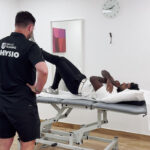
Ask any physio who has worked inside a professional sports club and they will tell you the same thing: the best injury is the one that never happens. At the top level, a player in the treatment room costs matches, points and money, so clubs put enormous effort into keeping athletes available.
Here is the good news. Very little of what elite clubs do is secret, and almost none of it needs a professional budget. Whether you are training for a marathon, playing padel four times a week or getting back into football after years away, you can use the same thinking. These are the ten rules our senior physios would give any athlete who walked through our door.
FIRST, STOP THINKING OF INJURY AS BAD LUCK
Most people see injuries as random: a wrong step, a dodgy knee, getting older. In elite sport, we see most injuries as a mismatch between two things.
- Load: everything you put your body through, including distance, sessions, intensity, and even stress and poor sleep.
- Capacity: how much your muscles, tendons, bones and joints can tolerate.
Injury happens when load outruns capacity. Every rule below either manages your load sensibly or builds your capacity.
This surprises people: training a lot is rarely the problem. Athletes who are well prepared for high training volumes are often less likely to get injured than those who train lightly. The danger isn't hard work. It is hard work you haven't built up to.
THE TEN RULES ELITE PHYSIOS LIVE BY
RULE 1: WATCH FOR SPIKES, NOT TOTALS
In professional clubs, every session is logged. The most useful thing we look at isn't how much an athlete did this week. It is how this week compares with their average over the past month. Sudden jumps above that recent average are where injuries cluster.
Try this: after each session, give it an effort score from 1 (very easy) to 10 (maximal) and multiply it by the minutes you trained. A 45 minute run at an effort of 6 scores 270. Add up your week and compare it with your average week over the last month. Small increases are generally well tolerated. A week that is half as much again as your recent average is a warning sign.
Dubai has its own version of this. When the weather cools in October, race entries open, padel leagues restart and training goes from very little over the summer to a full schedule in a matter of weeks. A few weeks later, sore calves, Achilles tendons and shins tend to follow. Ease back in, even if you feel ready to go.
RULE 2: TEST, DON'T GUESS
Before a season starts, professional athletes complete a set of baseline tests covering strength, power, movement and balance. This shows weaknesses before they turn into injuries, and if an athlete does get hurt, we know exactly what we are rebuilding toward.
You can run a simple version at home:
- Single leg calf raise: stand on one leg on the edge of a step and rise up and down fully at a steady pace until you can't keep good form. For runners, many sports physios look for at least 25 quality repetitions on each leg.
- Single leg squat: in front of a mirror, squat slowly on one leg. Watch whether your knee drifts inward or your hips drop to one side.
- Single leg balance: stand on one leg with your eyes closed. Struggling to reach 20 to 30 seconds suggests your balance needs work.
The most important thing is to compare your left and right sides. In elite sport, a clear difference between sides is one of the first things we follow up, because the weaker side is usually the one that gets hurt.
RULE 3: LIFT HEAVIER THAN YOU THINK YOU NEED TO
Bodyweight exercises are a good starting point, but tendons and bones respond to load. Slow, heavy strength work is one of the most effective tools we have for building tendons that can cope with sport.
Consider the numbers. When you run, your calves handle forces of several times your body weight with every single stride. Twenty bodyweight calf raises won't prepare them for a half marathon. Over time, you need to add weight.
Try this: two strength sessions a week, focusing on squats, lunges, deadlift variations and weighted calf raises. Choose a weight where you can complete 6 to 10 controlled repetitions, with the last two feeling genuinely hard. If you are new to lifting, have a physio or qualified coach check your technique before you add weight.
RULE 4: PROTECT YOUR HAMSTRINGS WITH TWO TOOLS
Hamstring injuries are among the most common injuries in football, rugby and any sport that involves sprinting. Elite clubs rely on two tools to prevent them.
The first is the Nordic hamstring curl. Kneel on a soft surface with a partner holding your ankles, then lower your body forward toward the floor as slowly as you can, using your hands to catch yourself at the bottom. Studies in football have shown that programs including this exercise can cut hamstring injuries by around half. Start with two sets of four to five repetitions, once or twice a week.
The second is regular sprinting. Running close to your top speed once a week prepares your hamstrings for the demands of a match. The weekend footballer who never sprints during the week, then sprints flat out on Saturday, is exactly the player we see on Monday. After a good warm up, add four to six short sprints at around 90% effort to one session each week.
RULE 5: TRAIN YOUR SPRINGS
Running, padel, tennis and football all rely on your tendons acting like springs, storing and releasing energy with every step and change of direction. Strength training builds the engine, but you also need to train the springs.
Start with low level hopping and skipping: small, quick hops on the spot, skipping with a rope, gentle jumps with soft, quiet landings. Build gradually toward bounding, side to side hops and jumps with changes of direction.
This matters for padel players in particular. Calf strains are common in people new to the sport, because quick lunges and sudden pushes off the back foot ask a lot of calves that aren't used to it.
RULE 6: WARM UP WITH A PURPOSE
A structured warm up does far more than get you sweating. Programs such as the FIFA 11+, used in football, have been shown in research to reduce injuries in amateur players by around a third.
A good warm up takes 10 to 15 minutes and follows a clear order:
- Raise your heart rate with light jogging or skipping.
- Move your joints through their full range with leg swings, lunges and hip rotations.
- Switch on key muscles with exercises like glute bridges and calf raises.
- Build up to sport speed with strides, changes of direction or practice shots.
Long, held stretches before exercise aren't necessary for most people. Save them for later if they help you feel looser.
RULE 7: TREAT SLEEP AND FOOD AS PART OF YOUR TRAINING
In elite sport, we monitor sleep almost as closely as training. Research in young athletes found that those regularly sleeping less than eight hours a night were noticeably more likely to be injured than those who slept more.
Food matters just as much. Not eating enough to fuel the training you do is one of the main causes of bone stress injuries, particularly in endurance athletes and in people trying to lose weight while training hard. Warning signs include ongoing tiredness, frequent colds, slow recovery and, for women, changes to their menstrual cycle.
Try this: each morning, score your sleep, muscle soreness, energy and mood from 1 to 5. Professional clubs use a version of this every day. If two or more scores are low, swap your hard session for an easy one. One missed session costs you nothing. Six weeks out injured costs you a great deal.
RULE 8: USE THE TRAFFIC LIGHT RULE FOR PAIN
Not all pain means stop. Many common niggles, especially in tendons, are managed by staying active within limits. Elite physios use a simple scale to guide this, from 0 (no pain) to 10 (the worst pain imaginable):
| PAIN LEVEL | LIGHT | WHAT TO DO |
|---|---|---|
| 0 to 3 | Green | Generally fine to keep training, as long as it settles by the next morning |
| 4 to 5 | Amber | Reduce your distance, speed or intensity |
| 6 and above | Red | Stop, and get it assessed |
The next morning is your best guide. If the area feels worse than it did before your session, you did too much, so ease off for a few days.
This rule doesn't apply to sudden sharp pain, swelling, pain when you press on a bone, or pain that changes the way you move. Those need to be looked at by a professional.
RULE 9: FINISH YOUR REHAB
The biggest risk factor for an injury is a previous injury. That is often because rehabilitation stopped too early.
In elite sport, an athlete returns based on results, not time. Before they play again, their strength needs to match the other side, they need full movement and they need to pass tests that mimic the demands of their sport. Most people stop their rehab when the pain stops, which is usually well before full strength has come back. If you have had an injury in the past year, it is worth checking that it is truly finished.
RULE 10: RESPECT THE HEAT, AND MEASURE IT
Your body takes around 10 to 14 days of regular exposure to adjust to training in the heat. Until then, the same pace feels harder, you tire sooner, and tired muscles are more vulnerable. Run by effort or heart rate rather than pace on hot or humid days.
Professional teams also weigh athletes before and after training. Try this: weigh yourself before and after a long session. Each kilogram lost is roughly one liter of fluid, and aiming to drink about one and a half times that amount over the following hours, with added electrolytes, is a sensible target.
IF YOU ONLY DO THREE THINGS
- Build up gradually and avoid sudden jumps in training.
- Do two strength sessions a week, and keep making them harder.
- Get any niggle that changes how you move looked at early.
HOW UPANDRUNNING BRINGS ELITE SPORT THINKING TO YOU
You don't need to play for a professional team to train with a professional approach. UPANDRUNNING is a physician-led sports medicine and rehabilitation clinic with five locations across Dubai, and our team works with athletes at every level, from first time runners to elite competitors.
- Performance testing: strength and power testing using the same type of technology used by many professional teams, so you know exactly where you stand, side by side.
- Physiotherapy: a strength and conditioning program built around your sport, your goals and your test results.
- Run Clinic: a detailed analysis of how you run, with practical coaching to help you move more efficiently.
- Sports medicine: if something is already sore, our doctors can give you a clear diagnosis and a plan to get you back to full training.
- Podiatry: foot and ankle assessments, footwear advice and custom orthotics where they are needed.
BOOK WITH UPANDRUNNING
For you: our Sports Medicine Doctors and Rehab team will test where you stand and build a plan around your sport and your goals. Book via WhatsApp on 04 343 9391 or call 04 518 5400.
For your club or team: to arrange baseline testing or an injury prevention workshop for your squad, email [email protected] and we'll put together a proposal.
Not Sure Where to Start?
Book an appointment with our doctors. We will create a personalized treatment plan for you.